
2026-08-24 · Marco Delgado
Selecting Moisture Resistant Cabinets For West Palm Beach Kitchens
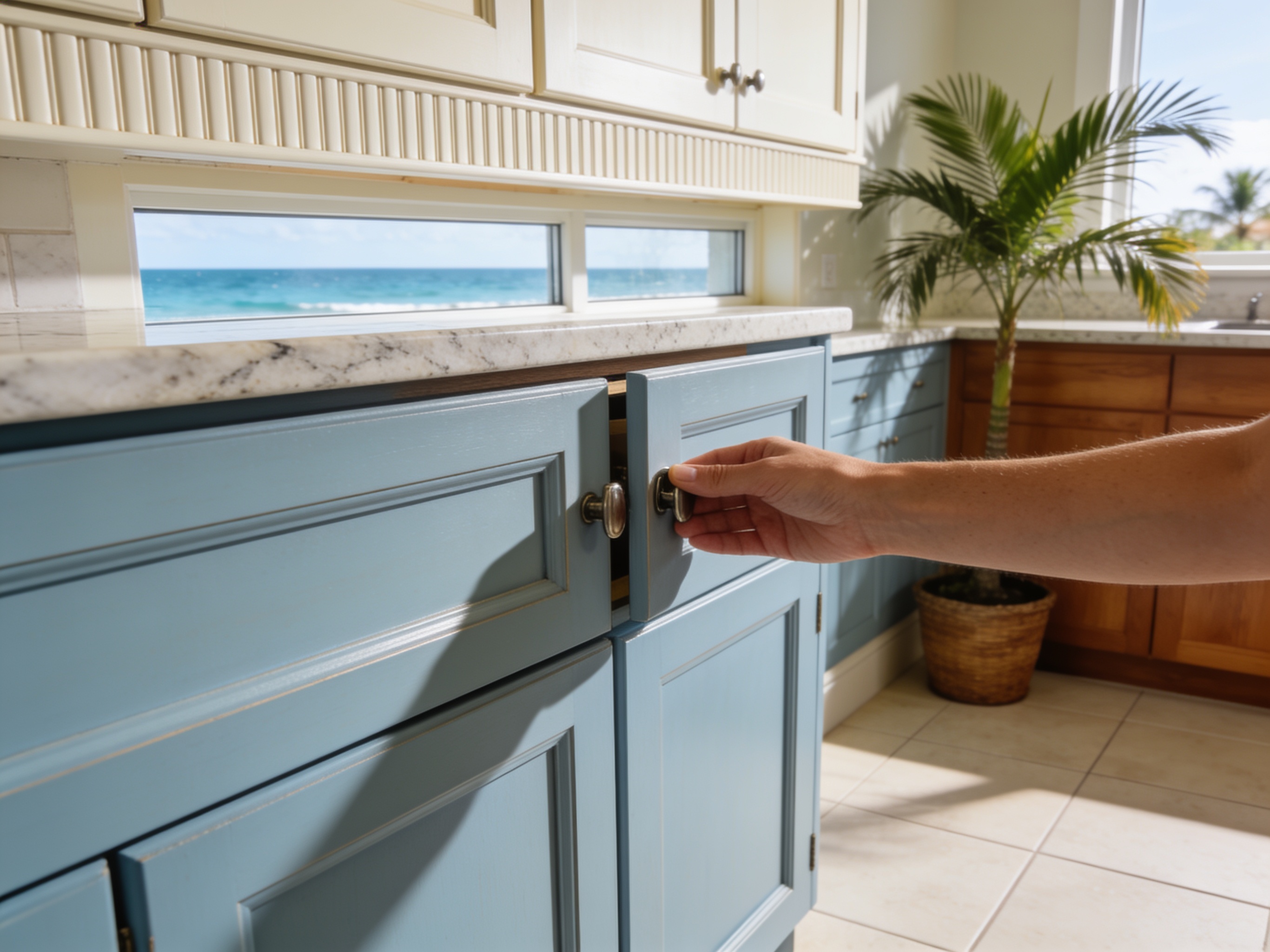
If you want cabinets that survive West Palm Beach humidity, the short answer is this: choose plywood boxes (3/4" birch or marine-grade for coastal blocks), thermofoil or conversion-varnish finishes over raw stained wood, and avoid standard particleboard entirely — a plywood-box semi-custom kitchen typically runs $12,000–$25,000 installed for 25–30 linear feet, roughly 15–25% more than the particleboard equivalent, and it is the single best money you'll spend. Our summers sit in the 80s with dew points near 75°F for months, and any kitchen that loses AC for three days after a storm becomes a humidity chamber. Particleboard swells irreversibly at the toe kick and under the sink; plywood dries out and keeps its screws. That's the whole argument in one paragraph — the rest is how to execute it.
Why Cabinet Boxes Fail Here (And It's Rarely The Doors)
Nearly every failed kitchen we open up in Northwood, Flamingo Park and Grandview Heights fails in the same three places: the sink base floor, the bottom 4" of the end panels, and the back panel behind the dishwasher. Doors and drawer fronts usually look fine. That's because failure is driven by liquid water plus sustained high humidity, not by daily use. A pinhole leak at a disposal slip joint drips 1–2 teaspoons a day — nothing dramatic — and in a 70%+ interior humidity environment that moisture never evaporates. Particleboard absorbs it, the resin bond releases, and the panel swells 1/4" and crumbles. Older housing stock makes it worse: many of the 1920s–1940s bungalows around El Cid and Grandview Heights have no continuous vapor barrier under the slab or crawlspace, and CBS block walls wick humidity from outside. If your cabinets back a masonry exterior wall, you want a 1/4" furring gap and a moisture-tolerant back panel, not raw MDF pressed against block.
Box Materials, Ranked For Palm Beach County
- Marine-grade / exterior-glue plywood (best): phenolic glue lines, void-free core. Best for sink bases and any run on an exterior block wall. Expect a $600–$1,500 upcharge across a typical kitchen if you spec it only where it matters.
- 3/4" cabinet-grade birch or maple plywood (the sweet spot): holds screws and hinge plates for 20–30 years, tolerates repeated humidity swings, and will dry out after a leak instead of disintegrating.
- HDF/high-density MDF with full thermofoil wrap (good, conditional): dimensionally very stable and paint-friendly, but only if every edge — including the bottom and the back cutouts — is sealed. One unsealed plumbing hole is the failure point.
- PVC / thermoplastic boxes (excellent, niche): genuinely waterproof, common in outdoor kitchens near the Intracoastal and Palm Beach waterfront homes. Softer, so hardware needs proper anchoring, and pricing lands near custom wood.
- Standard particleboard with melamine (avoid): fine in Denver, wrong here. It's what we tear out most often.
Finishes, Edges And The Details That Actually Decide Lifespan
Two identical plywood cabinets can perform 10 years apart based on finish. Conversion varnish and catalyzed lacquer cure into a hard, moisture-shedding film and hold up far better than site-applied wipe-on stains, which we simply don't recommend in this climate. If you want a painted Shaker look — the most requested style in the historic districts near Clematis Street and the Norton Museum of Art — insist the shop paints the inside of the door rails and the panel reveal, because that's where seasonal movement cracks paint and lets vapor in. Other specifics worth demanding in writing:
- Sealed bottom panels on every sink and dishwasher base, plus an aluminum or PVC drip pan.
- PVC or aluminum toe kicks instead of matching wood — the toe kick takes mop water and any storm intrusion first.
- Edge-banded plumbing cutouts: a raw sawn hole in an MDF deck is an open straw.
- Stainless or dry-lubricated hardware. Salt air off the Intracoastal reaches homes well inland; standard steel undermount slides can seize in 5–8 years, and stainless or coated hinges add only $150–$400 per kitchen.
Ventilation And Layout Matter As Much As The Cabinet
You can buy perfect cabinets and still cook them. Boiling pasta and running a dishwasher push interior humidity above 65% fast, and if the exhaust hood is a recirculating unit — extremely common in older Downtown West Palm Beach condos — that moisture lands right back on your uppers. Spec a ducted hood at 300–600 CFM, keep the duct run short, and pair it with make-up air where the code official requires it. Leave a 1/2"–1" air gap behind tall pantry cabinets on block walls. Also plan for storms: cabinet runs directly under a window are the ones that get soaked when a hurricane-season band drives water past an old wood sash. If layout changes are on the table, read up on how local building codes shape kitchen layout changes before you commit to moving the sink, and think about scheduling — timing a remodel around rainy season affects how long your kitchen sits open to the outdoors.
What To Spend, And Where To Stop
A practical budget split for a 25-foot West Palm Beach kitchen: put your money into plywood boxes, a ducted hood, and stainless hardware; save on door style, decorative molding and glass inserts. Stock plywood-box lines from a good dealer often outperform expensive particleboard-core "custom" cabinets. Expect 20–30 years from properly finished plywood with sealed sink bases, versus 8–12 years for particleboard in a humid coastal kitchen — and much less if it ever floods. If you're weighing options for custom cabinet installation or a full kitchen remodel, ask any contractor to show you the sink base construction on a sample, not a brochure. We're happy to walk homeowners in West Palm Beach, Lake Worth and Boynton Beach through the material spec sheet before anyone signs anything — reach us Mon–Fri 8am–5pm or Saturday 9am–12pm.